- SynCausal™ technology
CAE for Therapeutics
Computer-Aided Engineering for Therapeutics
Build a model of patient biology. Simulate an intervention. Explore the predicted molecular response.
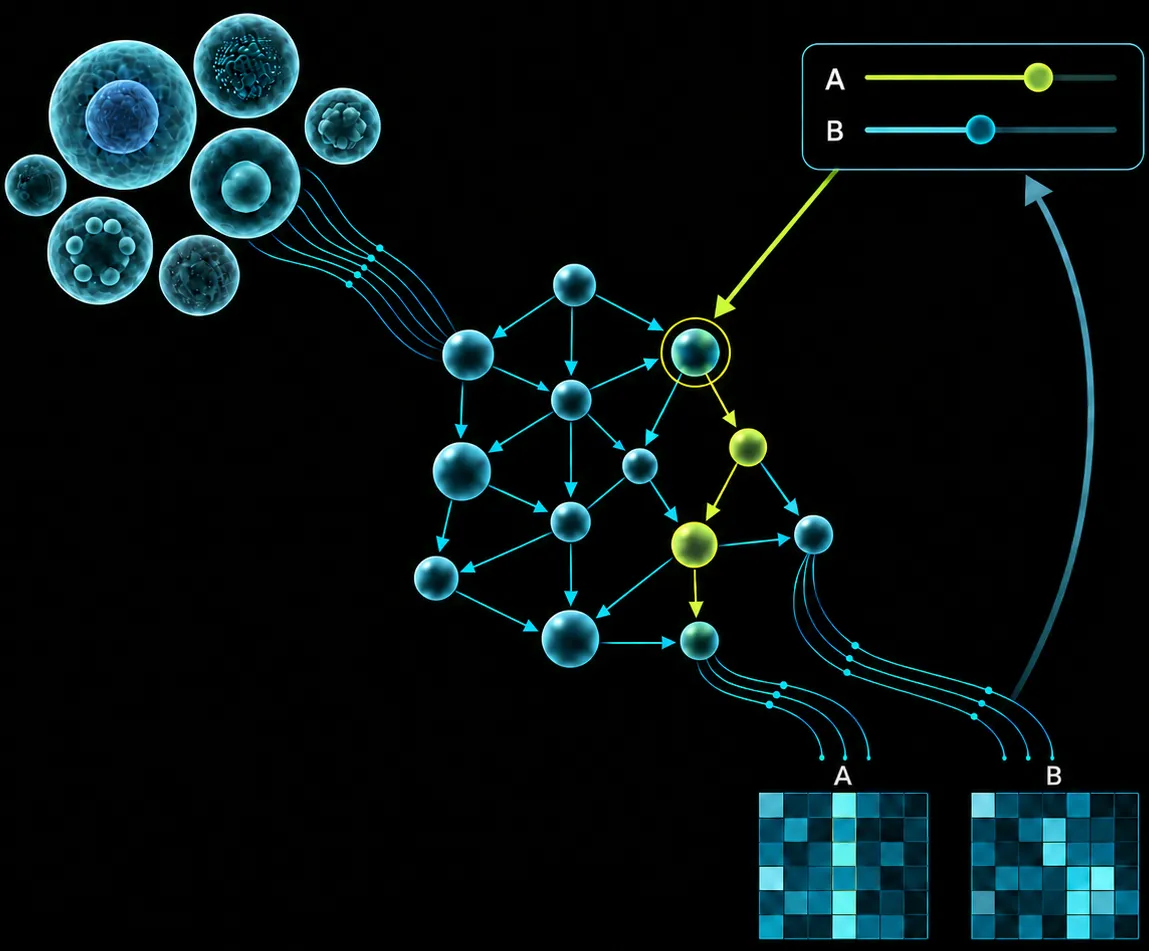
SynCausal™ combines single-cell data from primary patient samples with causal modeling to investigate how biological interventions may affect patients and cell types.
How SynCausal™ works
Patient-context causal simulation
01
Patient data
Single-cell gene expression with disease, tissue, and cellular context.
02
Causal discovery
Infer regulatory relationships from biological variation.
03
Causal inference
Simulate a specified target, gene, or pathway intervention.
04
Molecular prediction
Estimate downstream gene-expression profiles in patient context.
Causal context data infrastructure
A data foundation for patient-native causal AI
Primary patient data and proprietary enhancement
Synlico’s infrastructure combines 300 million raw cells from 40,000+ publicly sourced primary patient samples spanning 700+ indications with deep curation, raw-data reprocessing, chemistry resolution, and a critical proprietary data enhancement model.
The enhancement model learns from the full data resource, enriching the foundation for causal modeling across patient, tissue, and cellular contexts.
Learning from biological heterogeneity
Natural variation in patients’ primary single-cell RNA sequencing data creates shifts in gene-expression patterns. These shifts can carry causal information analogous to signals from laboratory interventions.
SynCausal™ learns from these shifts. The scale and heterogeneity of the data enable Synlico to train a deep causal model with strong performance.
Molecular output & applications
One molecular foundation. Multiple R&D questions.
Predicted single-cell expression profiles
The same molecular output can be examined at the level of genes, pathways, or cell states. Researchers can design readouts and analyses that evolve with each program’s biological question.
01
Target & MoA discovery
Explore causal drivers, compare intervention hypotheses, and investigate the molecular programs underlying predicted effects.
02
Patient molecular response stratification
Investigate how predicted molecular responses differ across patient contexts, cell types, and cellular states.
03
Mechanistic toxicology
Explore potential on-target and pathway-related liabilities across relevant cellular contexts.
In development
- Long-term vision
Toward a sign-off layer across therapeutic R&D
Our ambition is to make validated causal simulation part of how therapeutic designs are evaluated across R&D, connecting computational predictions with experimental evidence and defined decision criteria.